My neighbor is 74. She has type 2 diabetes and lives alone. Her daughter called me one evening, worried sick — her mom had stopped checking her blood sugar because “the machine was too confusing.”
That hit me hard. Here’s a woman who manages her meals carefully, takes her medication on time, and walks every morning — but a poorly designed device was quietly putting her health at risk.
That story is more common than most people realize. Nearly 1 in 3 adults over 65 in the United States is living with diabetes. Yet most glucose meters on the market are designed for younger, tech-savvy users — tiny buttons, small fonts, complex setup, and confusing apps.
This guide is for seniors, caregivers, and family members who want a glucose meter that’s genuinely easy to use — not just marketed that way.
Why Standard Glucose Meters Are Hard for Seniors to Use
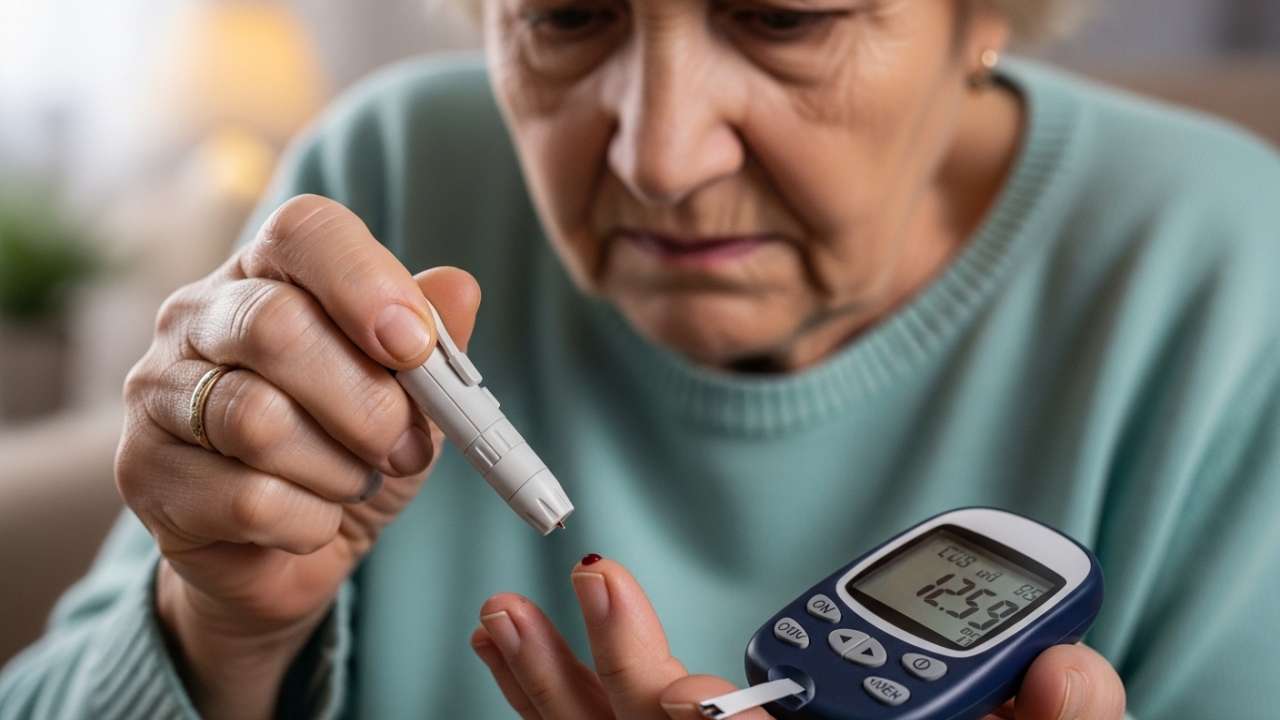
Before we talk about the best options, it’s worth understanding why most meters fail older adults.
Traditional blood sugar meters just weren’t made with aging in mind. Some of the most common challenges come from small, hard-to-see screens, complicated buttons, and devices that don’t work well with aging eyes or hands.
Specifically, seniors often struggle with:
- Vision changes — small numbers and dim screens are nearly impossible to read
- Arthritis or tremors — tiny buttons and fiddly test strips cause real frustration
- Memory concerns — multi-step processes lead to errors or avoidance
- Fear of pain — deep finger pricks make people dread testing
- Over-reliance on apps — many modern devices need a smartphone to work properly
A study by Regenstrief Institute researchers found that wearable glucose monitors and glucometers pose both wearability and use problems for older adults and their caregivers, highlighting the urgent need for manufacturers to improve device usability for this age group.
The result? Many seniors simply stop testing — which is when the real danger begins.
What Makes a Glucose Meter Senior-Friendly?
Not every meter earns the label “easy to use.” Here’s what actually matters for older adults:
Large, Backlit Display
Numbers should be readable without glasses in a dimly lit room. Look for a screen at least 1.5 inches in size with high contrast text. Backlit displays are non-negotiable for seniors with vision issues.
No-Coding Technology
Older meters required manual code entry before each new batch of test strips. It was confusing and led to errors. Today’s best meters are no-coding — you insert the strip and test. That’s it.
Small Blood Sample Requirement
Less blood needed means shallower, less painful finger pricks. The best senior-friendly meters need as little as 0.3 to 0.5 microliters — barely a pinprick.
Large, Easy-to-Handle Test Strips
Tiny strips are a nightmare for shaky hands. Wide, easy-load strips reduce spills and frustration significantly.
Fast Results
A good meter gives results in 5 seconds or less. No waiting, no second-guessing.
Audio / Talking Feature
For seniors with vision impairment, a talking meter that reads results aloud is life-changing. Several models now include this as a standard feature.
Simple Button Layout
One or two large buttons beat a complicated menu system every time for older adults.
Also Read:- Sleep Apnea Devices for Home Use: Treatment Options for Seniors in 2026
Normal Blood Sugar Levels for Elderly Adults — Know the Numbers
Before picking a meter, it helps to understand what you’re measuring.
Medical experts consider fasting blood sugar levels under 99 mg/dL normal, while readings between 100 and 125 mg/dL indicate prediabetes. For seniors specifically, the ideal fasting range is slightly more relaxed — generally 80–130 mg/dL — to reduce the risk of dangerous hypoglycemia episodes.
The American Diabetes Association recommends seniors maintain blood glucose levels below 180 mg/dL two hours after eating.
What’s considered dangerous for a senior?
- Blood sugar above 250 mg/dL can lead to ketoacidosis, a life-threatening condition requiring immediate medical attention. And if glucose drops below 54 mg/dL, severe hypoglycemia can occur, leading to confusion, seizures, or unconsciousness.
This is why consistent, daily monitoring matters so much — especially for seniors living alone.
Blood Sugar Reference Chart for Seniors
| Time of Day | Target Range (Seniors) | Concern Level |
|---|---|---|
| Fasting (morning) | 80 – 130 mg/dL | Below 70 or above 180 — call doctor |
| Before meals | 100 – 140 mg/dL | Below 70 or above 200 — act immediately |
| 2 hours after meals | Under 180 mg/dL | Above 250 — seek urgent care |
| Bedtime | 100 – 180 mg/dL | Below 90 — risk of overnight hypoglycemia |
Note: Individual targets vary. Always follow your doctor’s specific guidance.
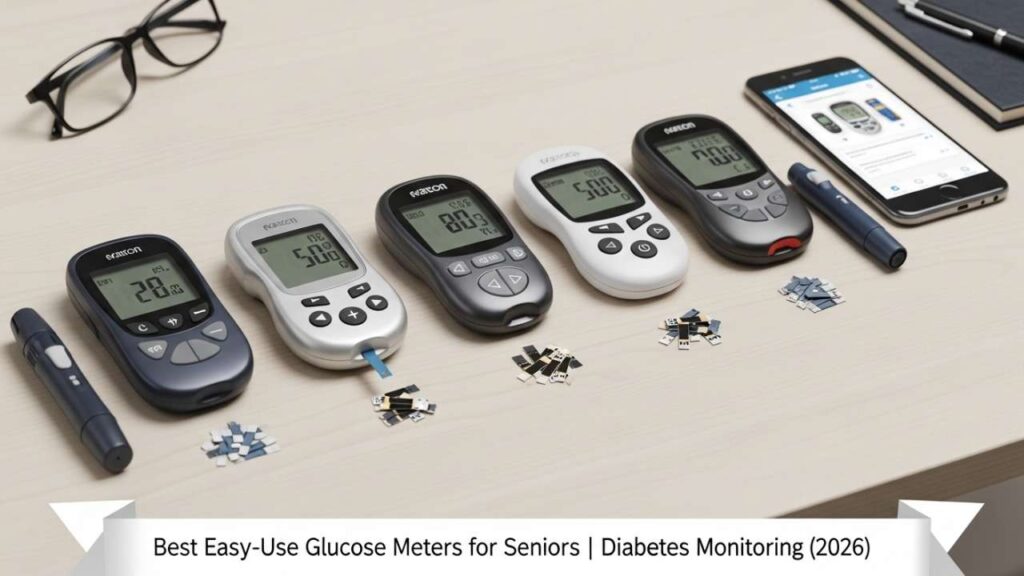
Best Easy-to-Use Glucose Meters for Seniors in 2026
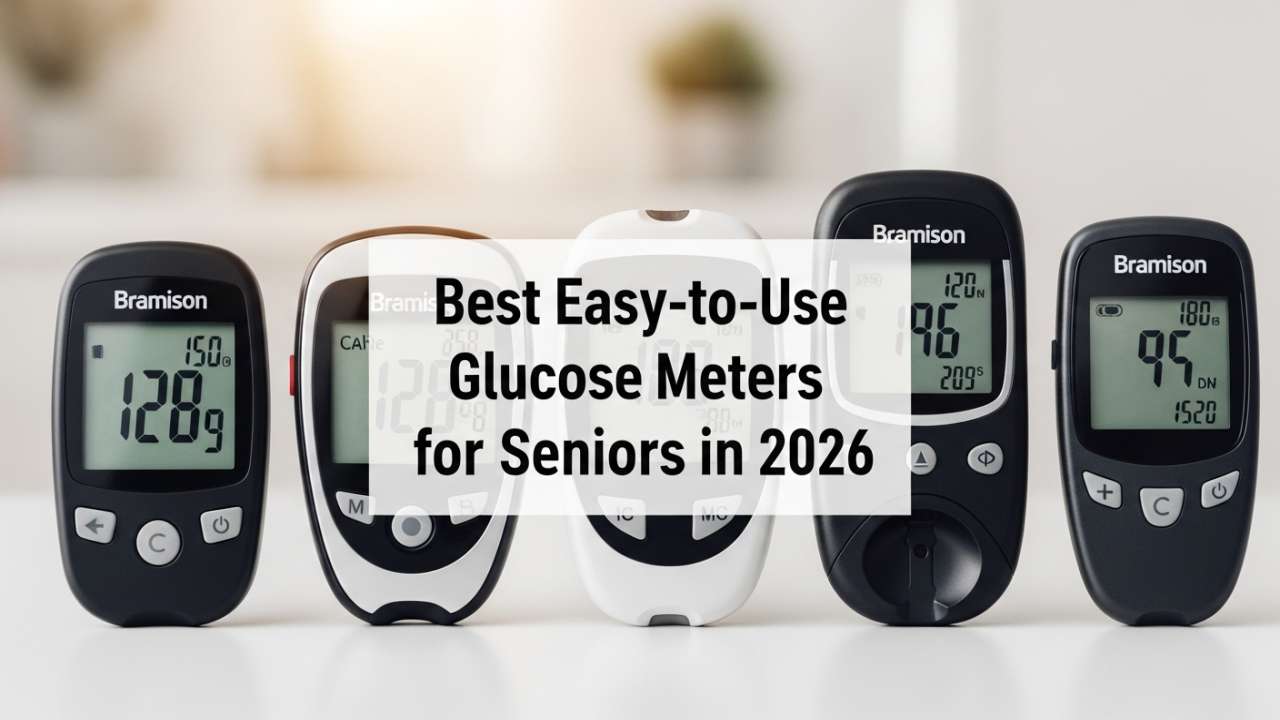
1. Contour Next One — Best Overall for Seniors
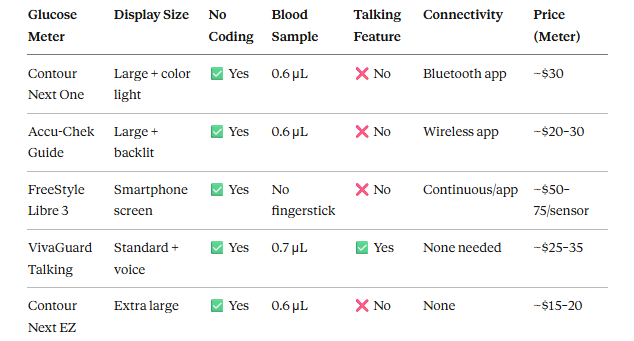
This is the meter I’d recommend to most seniors — and many diabetes educators agree. The Contour Next One is known for its proven accuracy, meeting stringent standards. It delivers fast, easy-to-read results and features seamless connectivity to a smartphone app for those who want it — but works just as well without one.
What makes it truly senior-friendly:
- SmartLIGHT feature — a color-coded indicator (green/amber/red) tells you instantly if your reading is in range, too high, or too low. No squinting at numbers required.
- Second-Chance Sampling — if you don’t get enough blood the first time, you can add more within 60 seconds without wasting a strip. This alone saves seniors a lot of frustration and money.
- No coding required — just insert the strip and test
- Requires only a tiny 0.6 microliter blood sample
- Results in 5 seconds
Best for: Seniors who want a reliable everyday meter without complexity.
2. Accu-Chek Guide — Best for Arthritis and Limited Dexterity
The Accu-Chek Guide was clearly designed with real-world use in mind. The Accu-Chek Guide Me Blood Glucose Meter boasts ease of use, fast results, and a spill-resistant SmartPack vial that lets you place the sample anywhere along the end of the test strip.
That spill-resistant vial is a game changer for seniors with tremors or stiff fingers. No more fumbling with tiny strip containers at 6 in the morning.
- Bright, backlit display with large numbers
- Strip port lights up in the dark — no fumbling
- Wireless connectivity to the Accu-Chek Connect app
- Softclix lancing device is considered one of the most comfortable available
- No coding needed
Best for: Seniors with arthritis, hand tremors, or limited dexterity.
3. FreeStyle Libre 3 — Best for Pain-Free Continuous Monitoring
For seniors who dread the daily finger prick, the FreeStyle Libre 3 changes the game entirely. Instead of pricking a finger multiple times a day, a small sensor worn on the back of the upper arm measures glucose continuously — and sends real-time readings directly to a smartphone every minute.
- No routine finger pricks required
- Real-time glucose readings 24/7
- Automatic alerts for high and low glucose levels
- Sensor lasts 14 days before replacement
- Results shareable with caregivers or family remotely
The setup does require a smartphone, which can be a learning curve. But once it’s running, the daily experience is dramatically simpler than traditional fingerstick testing.
Best for: Seniors who test frequently, have painful fingers, or whose family members want to monitor remotely.
Also Read:- Sleep Apnea Devices for Home Use: Treatment Options for Seniors in 2026
4. VivaGuard Talking Glucose Monitor — Best for Vision-Impaired Seniors
This one deserves more attention than it gets. The VivaGuard Talking Blood Glucose Monitor reads your results aloud, step by step — from “insert test strip” to “your blood sugar is 112.” No screen-reading required at all.
- Full voice guidance through every step
- Large buttons with clear labels
- No coding required
- 100 test strip and lancet kit included
- Carrying case included for travel
For seniors with macular degeneration, cataracts, or significant vision loss, this device restores independence in a way no standard meter can.
Best for: Seniors with visual impairment or low vision.
5. Contour Next EZ — Best Budget-Friendly Pick
The Contour Next EZ strips away the app connectivity and smart features and focuses entirely on being simple and affordable. The Contour Next EZ Blood Glucose Monitoring System is designed to have an easy-to-read display and straightforward test strip insertion.
- Very large display — one of the biggest on any glucose meter
- Minimal button navigation
- No coding
- Results in 5 seconds
- Typically available under $20 for the meter itself (strips sold separately)
It won’t sync to your phone or give color-coded feedback, but for a senior who wants to check their blood sugar quickly and clearly without any tech fuss — it does exactly that.
Best for: Seniors on a budget who want maximum simplicity.
Top Picks — Feature Comparison Table
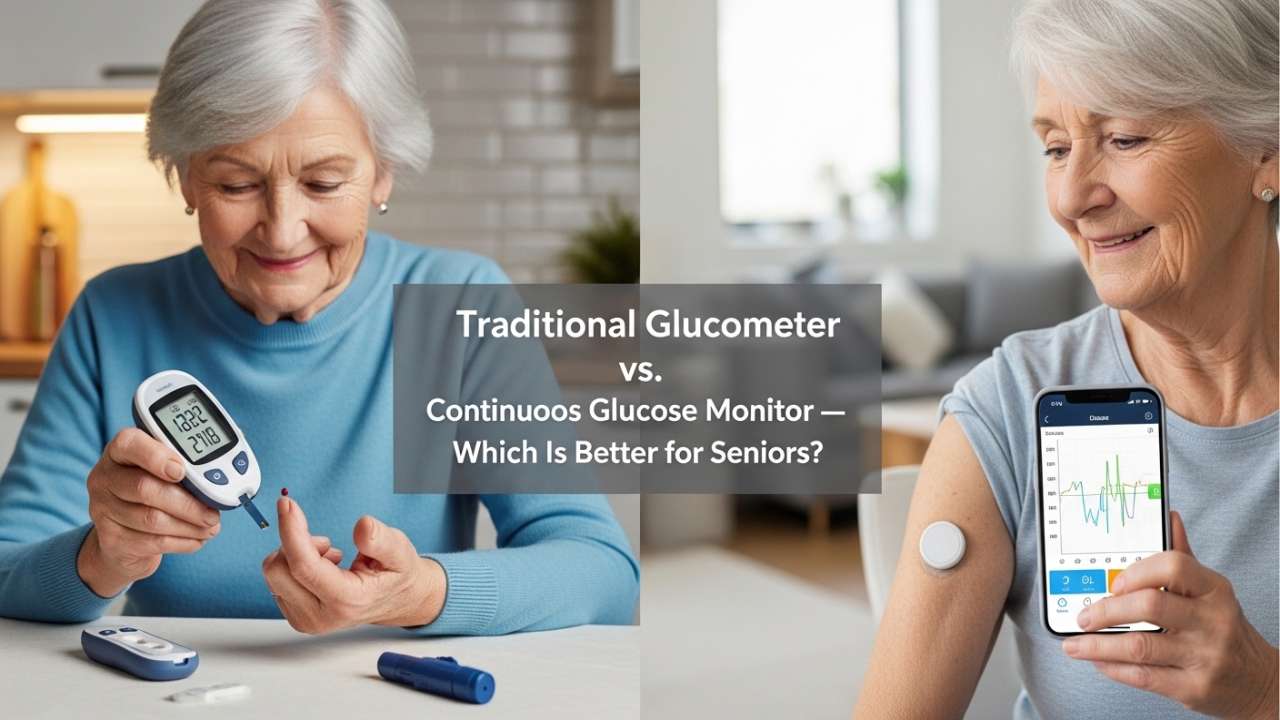
Traditional Glucometer vs. Continuous Glucose Monitor — Which Is Better for Seniors?
| Traditional Glucometer | Continuous Glucose Monitor (CGM) | |
|---|---|---|
| Finger pricks needed | Yes — each test | No routine pricks |
| Frequency of testing | On demand | Continuous — every 1–5 min |
| Real-time alerts | No | Yes — high/low alarms |
| Ease of setup | Very simple | Moderate (sensor placement) |
| Cost | Low (strips ~$0.20–0.50 each) | Higher (sensor ~$50–75 per 14 days) |
| Good for senior alone? | Yes — simple spot check | Yes — family can monitor remotely |
| Insurance covered? | Usually yes | Often covered for Type 1; varies for Type 2 |
For most seniors with Type 2 diabetes doing routine self-monitoring, a traditional no-coding glucometer like the Contour Next One is the most practical choice. For seniors with Type 1 diabetes, frequent hypoglycemia, or those whose families want remote visibility — a CGM like the FreeStyle Libre 3 is worth the investment.
Also Read:- Best Heart Rate Monitor for Elderly — Easy, Accurate & Doctor-Trusted Picks (2026)
How Often Should Seniors Check Blood Sugar?
Very high blood glucose levels (hyperglycemia) or very low blood glucose levels (hypoglycemia) can put health at serious risk. How often a senior should check depends on a number of individual factors, including whether they use insulin, their medication type, and their doctor’s guidance.
As a general guideline:
- Not on insulin: Once daily, typically fasting in the morning — or as directed by a doctor
- On insulin (once daily): 2–3 times per day — fasting + before bed at minimum
- On insulin (multiple doses): Before each meal and at bedtime
- Feeling unwell or symptoms of low/high blood sugar: Check immediately, regardless of schedule
Tips for Seniors Using a Glucose Meter at Home
- Wash hands with warm water before testing — not alcohol wipes. Cold hands give inaccurate readings.
- Use the side of the fingertip, not the tip itself — it’s less painful and has fewer nerve endings.
- Rotate fingers — using the same finger repeatedly leads to calluses and harder pricks.
- Store test strips at room temperature — heat, humidity, and direct sunlight all degrade accuracy.
- Log readings with the time and what you ate — patterns tell your doctor far more than single numbers.
- Check the expiry date on test strips — expired strips give wrong readings. It’s easy to miss.
- If a reading seems wrong, test again — a single reading can be affected by residue on your finger.
- Keep a spare meter — if your primary meter fails, you need a backup ready.
What Insurance Covers for Senior Glucose Meters
This matters a lot and gets overlooked.
Insurance coverage varies significantly. Some companies cover only certain meters or limit how many tests you can take. Test strips cost the most over time, so checking what your insurance plan covers before buying is essential.
Key things to check:
- Medicare Part B covers blood glucose monitors, test strips, and lancets for seniors with diabetes — but only for meters and strips that appear on the Medicare-approved list
- Medicare Advantage plans may have different formularies — always verify
- CGMs like FreeStyle Libre are increasingly covered, especially for insulin-dependent seniors
- A doctor’s prescription often enables full or partial reimbursement even for over-the-counter purchases
Always call your insurance provider before purchasing. The meter itself is often the cheapest part — strips are the ongoing cost.
Frequently Asked Questions
What is the easiest glucose meter for seniors to use?
The Contour Next One and Contour Next EZ are widely considered the easiest traditional meters for seniors. The SmartLIGHT color system on the Contour Next One eliminates the need to interpret numbers — green means you’re in range, red means you need attention. For seniors with vision impairment, the VivaGuard Talking Monitor is in a category of its own.
What blood sugar level is dangerous for an elderly person?
Readings above 250 mg/dL or below 70 mg/dL are cause for concern and should be reported to a doctor immediately. Seniors are particularly vulnerable to hypoglycemia unawareness — a condition where low blood sugar doesn’t produce normal warning symptoms like shaking or sweating, making undetected drops more dangerous.
Do seniors need a prescription for a glucose meter?
No. Most standard blood glucose meters and test strips can be purchased over the counter without a prescription. However, having a prescription from a doctor often enables insurance coverage or Medicare reimbursement — so it’s worth asking your healthcare provider to write one.
Can a senior use a glucose meter without a smartphone?
Yes, absolutely. Meters like the Contour Next EZ, Accu-Chek Guide Me, and VivaGuard Talking Monitor work completely independently — no phone, no app, no internet required. The FreeStyle Libre 3 CGM does require a smartphone for real-time readings, but even it stores data that can be downloaded later.
What is a normal fasting blood sugar for a 70-year-old?
For most seniors, a fasting blood glucose between 80 and 130 mg/dL is considered acceptable. For most older adults, a fasting glucose target range of 90–150 mg/dL is reasonable, though goals should be adjusted based on overall health and individual comorbidities. Always follow your doctor’s specific target range.
Are talking glucose meters reliable?
Yes. Talking meters like the VivaGuard and the PRODIGY AutoCode are clinically accurate and FDA-cleared. The voice function is purely an accessibility feature — it doesn’t affect the measurement mechanism. They’re as reliable as any standard glucometer.
How do I reduce the pain of finger pricks for an elderly parent?
Use the side of the fingertip rather than the center, warm the hand first with warm water, use a lancing device with adjustable depth (set it to the shallowest setting that still produces a small drop), and rotate fingers regularly. Meters requiring very small blood samples (0.3–0.6 µL) allow for shallower pricks. A CGM like the FreeStyle Libre 3 eliminates routine finger pricks entirely.
Is continuous glucose monitoring better than a fingerstick meter for seniors?
It depends on the senior’s situation. CGMs offer real-time data and alerts without repeated pricks — ideal for seniors who test frequently or live alone. Traditional fingerstick meters are simpler, cheaper, and require no sensor setup — better for seniors with straightforward monitoring needs. Many caregivers use both: a CGM for daily visibility and a fingerstick meter as a backup.
Final Thoughts
Diabetes management in older age shouldn’t be a battle with your equipment. The right glucose meter for a senior is one that fits their hands, suits their vision, gives a quick clear answer, and doesn’t require a 10-step setup every morning.
For most seniors, the Contour Next One hits that mark best. The color-coded feedback and second-chance sampling genuinely reduce anxiety and errors. For seniors with arthritis, the Accu-Chek Guide is hard to beat. For those who want to skip finger pricks altogether — the FreeStyle Libre 3 is worth every rupee.
And for any senior with vision impairment — please look at the VivaGuard Talking Monitor before defaulting to a standard screen-based meter. Independence in blood sugar testing is possible, even without perfect eyesight.
Talk to your doctor or a certified diabetes educator before making a final decision — they’ll help you match the device to the individual’s health needs, not just general preferences.