Medical Alert Systems The Villages, Florida: The Complete 2026 Guide for Active Villagers
If you live in The Villages — or you’re helping someone you love who does — you already know this community does not slow down for anybody. The golf carts are moving by 7 a.m. The pickleball courts fill up before breakfast. The pools are busy, the recreation centers are buzzing, and by sundown, there are at least three events happening within a two-mile radius of wherever you’re standing.
That’s the beauty of The Villages, Florida. It’s the largest retirement community in the United States, home to more than 130,000 residents across three zip codes (32159, 32162, and 32163), and it operates at a pace that frankly embarrasses most cities half its age.
But here’s the truth that no one loves to say out loud: being active and being invincible are two very different things. When you’re out on your golf cart at dusk on Morse Boulevard, or swimming laps alone in one of the 100+ recreation centers, or finishing up a round on one of the community’s 50+ executive and championship golf courses — the distance between a great day and a medical emergency can be measured in seconds. That is exactly why medical alert systems in The Villages are not just a “senior thing.” They are a smart, independent, active-lifestyle thing.
This guide covers everything you need to know to choose the right system. We’ll look at the eight best options, what makes them work specifically in this community, how golf cart safety factors into your decision, how The Villages’ own EMS infrastructure plays a role, and which system makes the most sense depending on how you actually live your life here.
Why The Villages Is a Unique Case for Medical Alert Systems
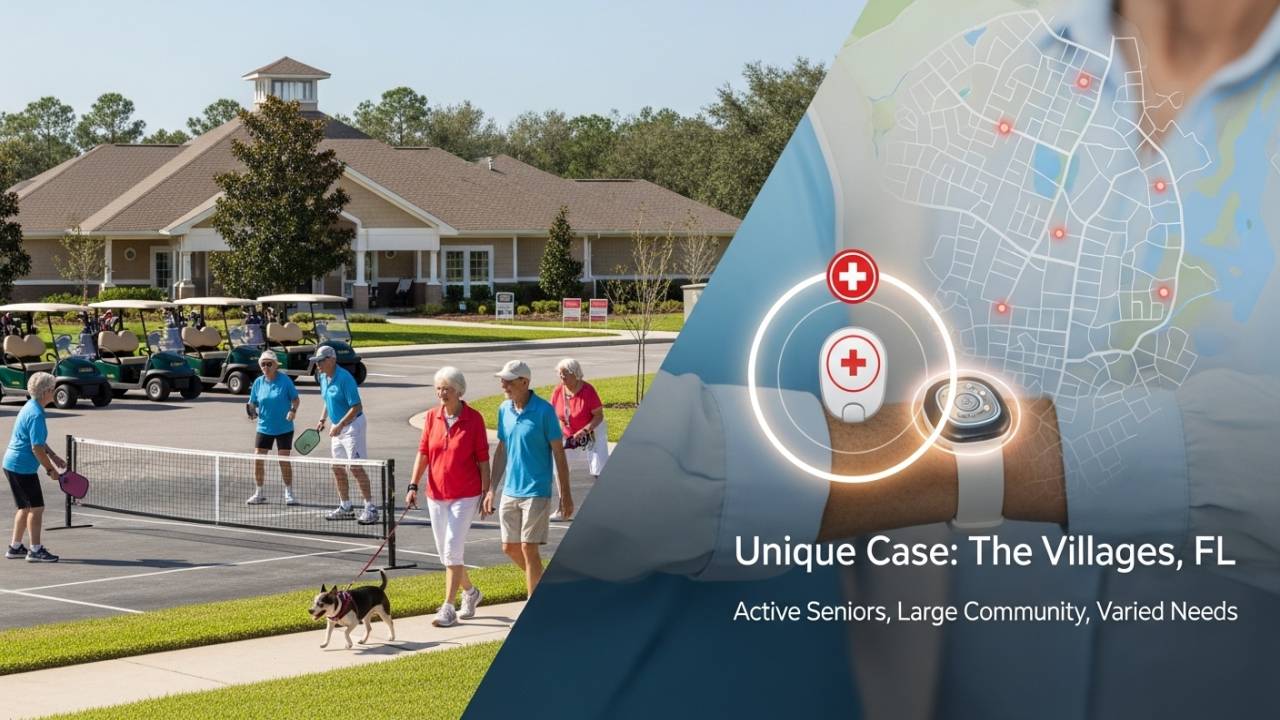
Most medical alert system guides are written for someone who lives in a suburban house, mostly stays home, and needs basic coverage. The Villages is not that situation — not even close.
Consider a few things that make this community unlike anywhere else in the country.
There are more than 50,000 golf carts registered in The Villages, and they are the primary form of transportation for most residents. These are not toys. They travel on roads shared with cars, trucks, and pedestrians. A peer-reviewed study published in a traffic injury prevention journal analyzed golf cart crashes in The Villages over an eight-year period and found that of 875 recorded crashes, 48% resulted in hospitalization, severe trauma, or death. Of those serious crashes, ejection from the cart occurred in 27% of cases. These are sobering numbers, and they paint a picture that is impossible to ignore when choosing medical alert systems for The Villages residents.
Beyond the carts, the sheer size of the community matters. Zip codes 32159, 32162, and 32163 cover a vast geographic area. If someone falls on a golf cart path on the north end of the community while their spouse is at a dance at Lake Sumter Landing, a basic home-based system with no GPS is going to be completely useless. You need GPS. Full stop.
The Villages also has its own hospital — UF Health The Villages Hospital — and its own EMS infrastructure through The Villages Public Safety Department. Response times here are genuinely good compared to rural or suburban communities elsewhere. But a fast EMS response still requires someone knowing where you are and what happened. That’s where the right medical alert system bridges the gap.
Finally — and this is something the tech community underestimates about this population — Villagers are extraordinarily tech-savvy. The average resident here is not intimidated by a smartphone app, GPS connectivity, or a smartwatch interface. They want devices that actually work well, look decent, and don’t make them feel like they’re giving up independence. They want the opposite of that.
Also Read:- GPS Trackers for Elderly in Florida
The 8 Best Medical Alert Systems for The Villages, Florida
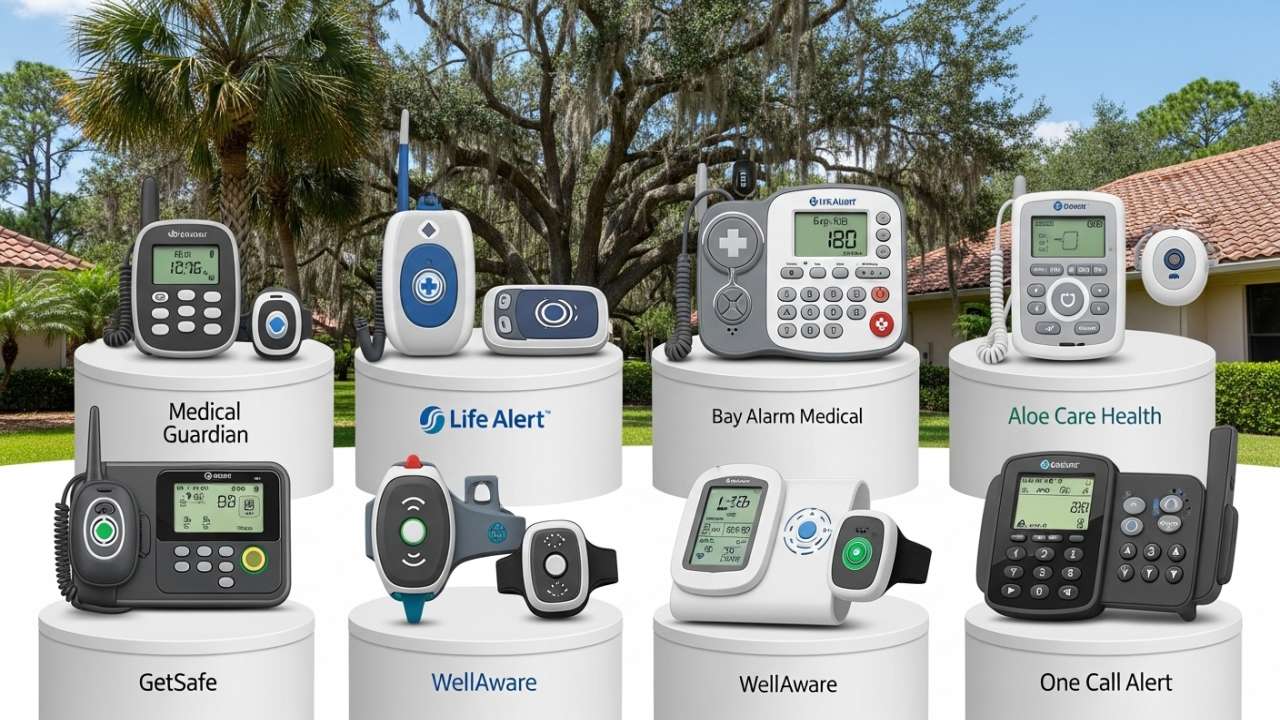
1. Bay Alarm Medical — Best Overall for Active Villagers
If you had to pick one system for the average Villager, Bay Alarm Medical is it. It consistently ranks at the top of independent reviews, including head-to-head tests by senior care specialists, and for good reason. The SOS All-in-One 2 is their mobile device — about the size of an earbud charging case — and it is built specifically for people who don’t spend their day sitting in a recliner.
It runs on AT&T’s 4G LTE network with GPS tracking, has up to 72 hours of battery life, is IP67 waterproof, and syncs to a caregiver app that shows real-time location. For golf cart use, you can tuck it in a pocket, clip it to a belt, or wear it around your neck. If something happens on the cart path, two-way communication connects you directly to a trained operator. Response times in independent tests averaged around 16 seconds — fast by any measure.
Monthly pricing starts at $24.95, with fall detection available as an add-on for an additional $10 per month. No long-term contracts. No activation fees. This is the system we’d recommend most confidently to a Villager who is active, tech-comfortable, and doesn’t want to think about it once it’s set up.
Best for: All-day golf cart users, active residents, anyone who leaves home regularly.
2. Medical Guardian — Best Fall Detection Technology
Medical Guardian earns its reputation specifically on the strength of its fall detection accuracy and its 1,400-foot pendant range, which is the longest of any major system on the market. For The Villages community, where residents might be in a large recreation center, moving between rooms, or out in a yard, that range matters more than most people realize.
The MGMini Lite is their standout portable device. It is small, lightweight, and uses GPS to log your location hourly — a genuinely useful feature if your daily routine takes you across multiple parts of the community. Their monitoring center staff are U.S.-based and professional, and customer service scored top marks in independent testing.
Pricing starts at $31.95 per month. Fall detection is an add-on at $10 per month. The MGMove smartwatch is also worth considering for Villagers who want something that looks like regular jewelry rather than a medical device.
Best for: Anyone with a fall risk history, residents with larger homes or properties, golf course walkers.
3. MobileHelp — Best for Snowbirds and Frequent Travelers
MobileHelp is headquartered right in Boca Raton, Florida, and it shows — their systems are designed for people who move around Florida’s geography and beyond. For snowbirds who split their time between The Villages and a northern home, or for residents who travel for grandchildren, cruises, or road trips, MobileHelp’s nationwide coverage is a genuine advantage.
Their cellular GPS system works anywhere there’s a signal, so transitioning from zip code 32162 in The Villages to a hotel in Sarasota for a weekend trip doesn’t require any setup changes. Fall detection is available. Pricing is competitive, and their setup process is notably simple.
Best for: Snowbirds, frequent travelers, residents who split time between two homes.
Also Read:- Fall Detection Devices Florida Seniors: The Complete 2025 Guide
4. Lively Mobile2 — Best for Technology Lovers
Villagers who use smartphones daily and love clean design will appreciate the Lively Mobile2. It can be worn as a necklace, wristwatch, or clipped to a belt. The fall detection is handled via a magnetic lanyard paired with an internal accelerometer, and in testing, the system connected to a live agent in as little as five seconds after a fall was detected.
What makes Lively stand out for The Villages specifically is the optional Urgent Response app integration, which adds an extra layer of check-in functionality that tech-comfortable residents genuinely use. The company is well-established and the device feels current — not like medical equipment from a decade ago.
Best for: Tech-forward residents, those who want a device that doesn’t “look” like a medical alert, active lifestyle users.
Also Read:- GPS Trackers for Elderly in Florida
5. PAL Button / Personal Alert Link — Best Local Option
PAL Button, operating as Personal Alert Link and affiliated with Crime Guard Security Systems, is actually a local company based right in The Villages at 333 Colony Blvd, Suite 171 in zip code 32162. They hold an A+ BBB rating and have been in business since 1996.
For residents who want the comfort of working with a company that actually knows The Villages community — that has local people answering phones, local familiarity with the community’s geography, and the kind of in-person support that a national brand cannot offer — PAL Button deserves serious consideration. They offer GPS tracking, personal emergency response systems, and medical alert services tailored specifically for local residents.
Best for: Anyone who prefers a local vendor, residents who value in-person support, those who want someone they can walk in and talk to.
6. Philips Lifeline — Best for Those Who Prefer a Trusted Name
Philips Lifeline has been in this space for decades and carries enormous name recognition, particularly with residents whose doctors have recommended a medical alert system. The HomeSafe system is reliable for in-home use, and their GoSafe2 mobile option adds GPS for on-the-go coverage with an integrated fall sensor.
The monitoring center is professional, the devices are simple and dependable, and for Villagers who want a brand their doctor recognizes and might have specifically mentioned, Lifeline delivers that credibility. Pricing is slightly higher than Bay Alarm Medical, and contracts can be more rigid, so read the fine print before signing.
Best for: Residents whose doctors recommended a specific system, those who value established brand reputation.
7. ADT Health — Best for Security-Minded Residents
ADT is a name every American over 60 knows from the home security world, and their medical alert division brings that same “set it and forget it” dependability to personal emergency response. Their mobile On-the-Go system includes GPS location tracking, and fall detection is available as an add-on.
For Villagers who already use ADT for home security — and many do — bundling a medical alert with an existing account can simplify billing and customer service. ADT Health’s response times are competitive, and the brand’s nationwide infrastructure means you’re covered whether you’re at the Square at Lady Lake or visiting family in Jacksonville.
Best for: Existing ADT security customers, residents who want a single vendor for home security and personal safety.
8. LifeStation — Best Budget Option Without Sacrificing Quality
LifeStation’s Sidekick pendant is one of the most lightweight devices in the category at just 1.4 ounces, and it uses a three-technology fall detection algorithm to distinguish real falls from false alarms — a genuinely thoughtful engineering approach for active users who move around a lot. Monitoring is U.S.-based and CSAA Five Diamond certified, which is the gold standard for monitoring center quality.
Pricing is budget-friendly, making LifeStation the right call for Villagers on a fixed income who cannot justify the cost of premium systems but refuse to go without coverage. The pendant range is 600 feet, shorter than Bay Alarm Medical or Medical Guardian, but more than adequate for most home environments.
Best for: Budget-conscious residents, those with straightforward in-home coverage needs, light activity users.
Also Read:- Fall Detection Devices Florida Seniors: The Complete 2025 Guide
Golf Cart Safety and Medical Alert Systems: The Conversation No One Is Having Enough
If you have been in The Villages longer than a week, you know the golf cart paths are their own ecosystem. Intersections, hills, blind curves, proximity to vehicles — it’s a lot. And the data confirms what residents who’ve lived here a while have seen firsthand. Golf cart incidents in The Villages have risen year over year, and in one recent quarter, Sumter County recorded over 50 cart crashes in three months alone.
The most important feature for golf cart use is not fall detection. It’s GPS. A fall detection sensor is calibrated for sudden downward impact — the kind you experience when your body hits the ground. A golf cart accident may involve a sideways collision, a rollover, or an ejection that registers differently. What GPS guarantees is that no matter what happened, your location can be found.
The second most important feature is two-way communication without a home base. Many older systems require a base unit sitting on your kitchen counter. That base unit cannot hear you when you’re on a golf cart path a mile from home. A fully mobile system with a built-in speaker and microphone — like the Bay Alarm Medical SOS All-in-One 2 or the Medical Guardian MGMini Lite — means you can actually communicate with an operator from wherever the incident occurred.
A few practical thoughts for Villagers who use their carts daily: Consider wearing your pendant under your shirt on a short enough lanyard that it sits firmly against your chest, not swinging freely. This reduces false alarms on bumpy paths and ensures the fall sensor is in the right position if something actually does happen. Also, charge the device each night. Most mobile medical alert devices have battery lives of 24-72 hours, but developing a nightly charging habit eliminates the risk of being caught with a dead device.
Also Read:- Elderly Care Technology in Florida: Transforming Senior Lives in the Sunshine State
The Villages EMS, Hospital, and Emergency Infrastructure
One thing that genuinely sets The Villages apart from many other retirement communities is the quality of its own emergency response infrastructure. UF Health The Villages Hospital serves the community, and the public safety department operates EMS services that are familiar with the geography, the golf cart paths, and the specific needs of the resident population.
This matters when choosing medical alert systems in The Villages because the job of your alert system is not to replace EMS — it’s to activate EMS faster and with better location information. A monitoring center that can relay your GPS coordinates directly to The Villages Public Safety Department instead of a generic 911 dispatch saves critical minutes. When evaluating any system, it is worth asking the provider explicitly: how does your monitoring center communicate location data to local EMS, and how familiar are your operators with routing calls to The Villages Public Safety Department versus a county dispatch center?
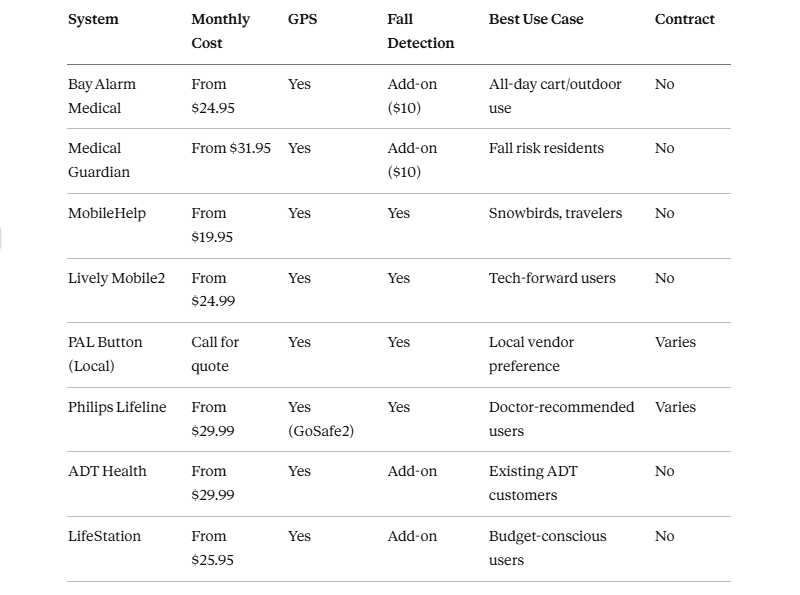
Comparison Table: Top Medical Alert Systems for The Villages
Active Lifestyle Monitoring: Golf, Swimming, Tennis, and More
Here’s something the generic medical alert guides never address: when you’re in the pool, you cannot press a button. When you’re on hole 14 of a golf course, you’re half a mile from the cart path. When you’re in the middle of a tennis rally, your hands are full and your focus is elsewhere.
The Villages lifestyle demands devices that work around your activity, not the other way around.
For swimming, waterproof rating is non-negotiable. Look for IP67 or IP68 ratings. Bay Alarm Medical’s SOS All-in-One 2 is IP67, which means it handles immersion up to one meter for 30 minutes — more than enough for pool use, though it should not be worn in a lap swimming race where the force of strokes might dislodge a pendant.
For golf, the lightweight devices win. Medical Guardian’s MGMini Lite and LifeStation’s Sidekick pendant are both under 1.5 ounces and clip comfortably to a belt or golf shirt pocket. GPS ensures that if you have a cardiac event on the back nine, your location is known.
For tennis and pickleball — the big ones in The Villages — wrist-worn devices carry a specific consideration. Research has consistently found that wrist-worn fall detectors generate more false alarms than pendant-style devices worn on the chest, simply because of the natural arc of arm movements. If you play a racquet sport daily, a chest pendant with fall detection is more reliable than a wristband option.
Also Read:- Elderly Care Technology in Florida: Transforming Senior Lives in the Sunshine State
How to Get Medical Alert Systems Installed in The Villages
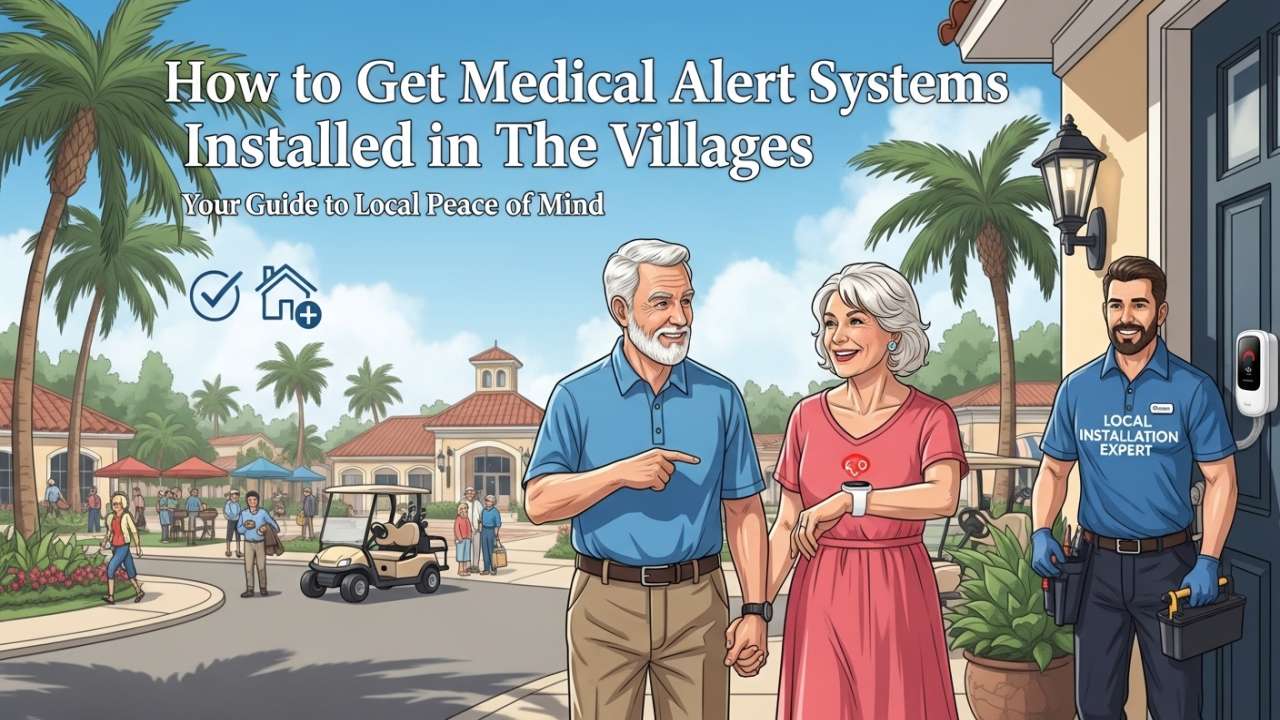
Most national providers ship their devices directly to your home — set-up typically takes under 15 minutes and involves plugging in a base unit if you have a home system, or simply charging and activating a mobile device if you’ve gone the all-mobile route.
For residents who prefer in-person setup and local support, PAL Button at 333 Colony Blvd in the 32162 zip code is the standout local option. The VHA (Villages Health Alliance) is also an excellent community resource. Their Helping Hands program provides free loaner medical equipment and their monthly Golf Cart Safety Clinic, held on the third Wednesday of every month, regularly discusses emergency preparedness including medical alert systems.
When you’re purchasing, ask specifically about whether the system uses AT&T or Verizon as its cellular backbone. Cell coverage across The Villages’ three zip codes is generally strong for both carriers, but if you know you have a weak signal spot near your home or favorite recreation center, that is worth confirming before you commit.
FAQ: Medical Alert Systems The Villages Florida
Q: Do I really need a GPS system, or will a home unit work? If you leave your home at all — and in The Villages, almost everyone does — you need GPS. A home unit is only useful when you’re within range of the base, typically 600-1,300 feet. The moment you’re on your golf cart, at a pool, or at a recreation center, a home-only unit cannot help you.
Q: Will my medical alert device work on all of The Villages’ golf cart paths? Any system using AT&T or Verizon 4G LTE will work across the vast majority of The Villages’ geography. There may be a small number of spots with reduced signal; your provider can tell you which carrier their system uses so you can verify coverage in your specific areas.
Q: Are there medical alert systems that work specifically with golf carts — mounted on the cart itself? There is no major provider that makes a cart-mounted system designed specifically for golf cart use in The Villages. The practical solution most residents use is a fully mobile pendant or clip-on device worn on their person while driving. This is actually more reliable than a cart-mounted solution, since it stays with you even if you are ejected from the cart.
Q: Does The Villages’ own hospital or EMS recommend a specific system? UF Health The Villages Hospital and The Villages Public Safety Department do not formally endorse specific commercial brands. However, the VHA Golf Cart Safety Clinic regularly discusses emergency preparedness, and attending one of those monthly sessions is one of the best ways to get community-specific guidance.
Q: What happens if I press the button accidentally while pickleball rallying? Almost all modern monitoring centers are trained for accidental activations — they are extremely common. When the operator responds, simply tell them it was an accidental press and they will log it and end the call. There is no penalty and no emergency response dispatched if you cancel in time.
Q: Can a family member in another state monitor my location through my medical alert device? Yes. Most GPS-enabled systems — Bay Alarm Medical, Medical Guardian, Lively, and MobileHelp all confirmed — have caregiver apps that allow a designated family member to see your real-time location, check battery life, and receive alerts if an emergency is triggered.
Q: Are medical alert systems covered by Medicare or insurance for Villages residents? Original Medicare Part A and Part B do not currently cover medical alert systems as a standard benefit. Some Medicare Advantage plans, which are very popular in The Villages area, do offer partial coverage or discounts. Check your specific plan’s benefits before purchasing, as this varies significantly.
Q: How long do I have to wait before help arrives after pressing the button? The monitoring center response — meaning a live operator answers your call — takes an average of 16-52 seconds depending on the provider, based on independent testing. Once you’re connected, the operator contacts EMS and provides your GPS location. With The Villages’ own EMS infrastructure, on-scene response times are typically well under the national average.
Our Community-Specific Recommendations
Every Villager is different, and “the best” medical alert system is always the one that actually fits how you live. Here’s how we’d break it down for the most common Villager profiles.
If you are on your golf cart every single day and spend more time outside than inside, Bay Alarm Medical SOS All-in-One 2 is the clear pick. GPS, waterproof, mobile, fast response, no contract.
If you have had a fall before or your doctor has expressed concern about your fall risk, Medical Guardian MGMini Lite is worth the slightly higher price for its superior fall detection accuracy and longer pendant range.
If you split time between The Villages and a northern home, MobileHelp is the smartest choice because your coverage moves with you across state lines without any changes.
If you want a local person to set it up, answer the phone, and know who you are, PAL Button is right here in zip code 32162 and has been serving this community since 1996.
And if budget is the primary consideration, LifeStation gives you professional monitoring, GPS, and quality fall detection at a price that does not require cutting anything else from your monthly budget.
The Villages was built on a simple idea: that retirement should feel like the best chapter, not a retreat into caution. A good medical alert system for The Villages residents doesn’t contradict that idea — it protects it. Wear one and go live your life.
This guide is updated for 2026. Pricing and features may vary by plan and provider. Always verify current pricing directly with the provider before purchasing. The Villages zip codes served: 32159, 32162, 32163.