Your dad calls you at 2 AM—he’s feeling short of breath again, but it’s not clear whether he needs the emergency room or just rest. You wish you had a way to know right now. That’s exactly when a pulse oximeter becomes your peace of mind. This small device, no bigger than a clothespin, clips onto a fingertip and tells you within seconds whether oxygen levels are truly concerning. For seniors managing heart disease, COPD, asthma, or simply wanting to catch early warning signs, a pulse oximeter isn’t luxury—it’s a safety net that lets you skip unnecessary ER visits and act fast when it matters. But here’s what surprised me: not all pulse oximeters are created equal for aging hands and eyes. Some displays are impossible to read, buttons confuse users, and accuracy can suffer. That’s why I went deep into how seniors actually use these devices at home—and what really matters.
What Is a Pulse Oximeter and Why Do Seniors Need One?
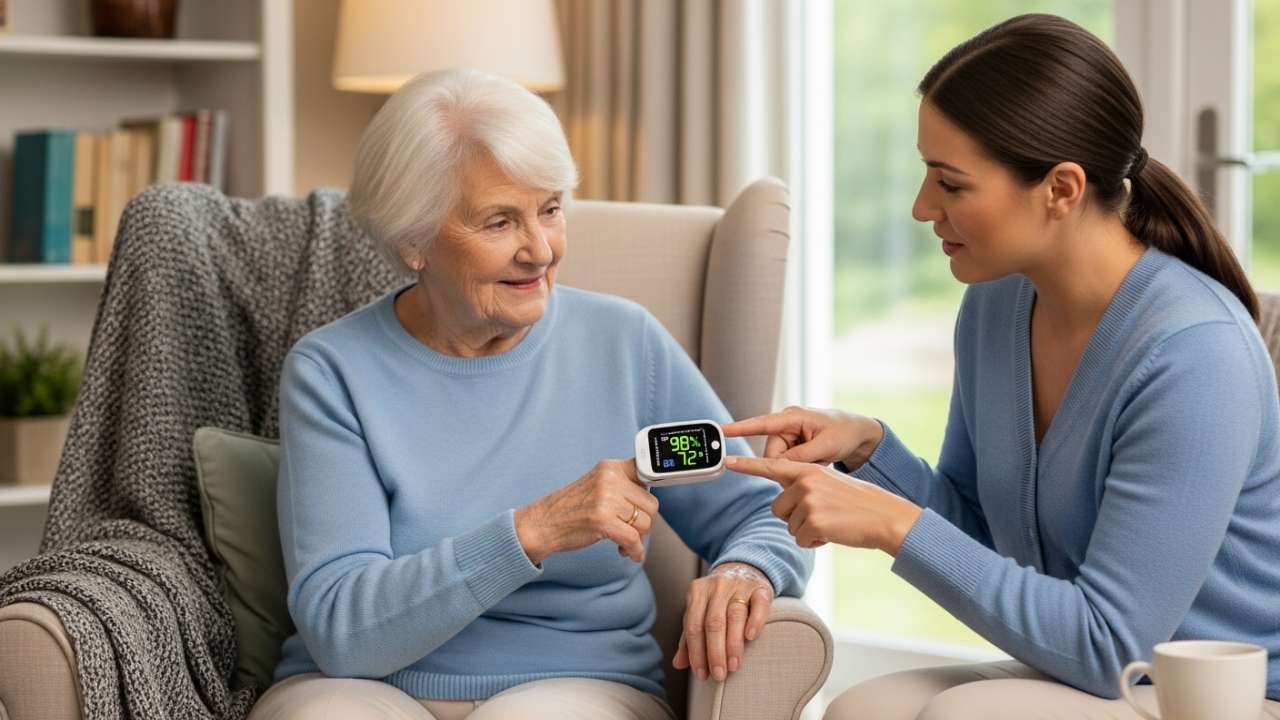
A pulse oximeter is a small electronic device that clips onto a fingertip, toe, or earlobe. It works by shining light through your skin and measuring how much oxygen is traveling in your blood, a metric called SpO2 (oxygen saturation). At the same time, it shows your heart rate. The entire measurement happens in 10-20 seconds, with zero pain and no needles.
For seniors, this matters because oxygen levels are an early warning system. If your SpO2 drops below 90%, that’s a red flag that something is wrong—before you feel too short of breath to move, before confusion sets in, before it becomes an emergency. This is especially critical if you have COPD, heart failure, asthma, or recovering from pneumonia or COVID-19. Monitoring from home means you can catch problems early, call your doctor, and avoid hospitalizations that disrupt your life and independence.
The beauty of a pulse oximeter is simplicity. Unlike blood pressure monitors with cuffs or glucose meters with needle sticks, a pulse oximeter just sits on your finger. You don’t have to undress, hold still for 30 seconds, or prick yourself. For seniors with arthritis, tremors, or vision problems, that ease of use is huge.
Also Read:- Best Easy-to-Use Glucose Meters for Seniors | Diabetes Monitoring (2026)
Why Seniors Are at Higher Risk—And Why Home Monitoring Helps
As we age, our lungs naturally lose some elasticity, and our heart’s efficiency declines. Add chronic conditions into the mix, and suddenly oxygen delivery becomes fragile. Seniors are disproportionately affected by:
- COPD and emphysema: Chronic obstructive pulmonary disease affects over 3 million older Americans, making even walking to the mailbox risky without knowing your oxygen baseline.
- Heart disease: A weakened heart pumps blood less effectively, so less oxygen reaches your tissues. A pulse oximeter can catch when it’s declining before chest pain starts.
- Asthma and reactive airway disease: Older lungs react differently to triggers; asthma in seniors is often underdiagnosed because symptoms are attributed to “just getting old.”
- Post-COVID complications: Long COVID in seniors can mean persistent low oxygen, fatigue, and exercise intolerance. Home monitoring helps you stay within safe limits.
- Pneumonia risk: Seniors recover slower from respiratory infections. A pulse oximeter during recovery tells you if the infection is turning serious.
- Sleep apnea: Undiagnosed or untreated, this condition causes overnight oxygen drops that damage the heart over time.
The research is clear: seniors who monitor their oxygen levels catch problems earlier, take action faster, and spend less time in hospitals. A 2025 survey by AARP found that 57% of seniors bought pulse oximeters on their doctor’s recommendation—not to be paranoid, but because early detection works.
Understanding Normal SpO2 Readings for Seniors
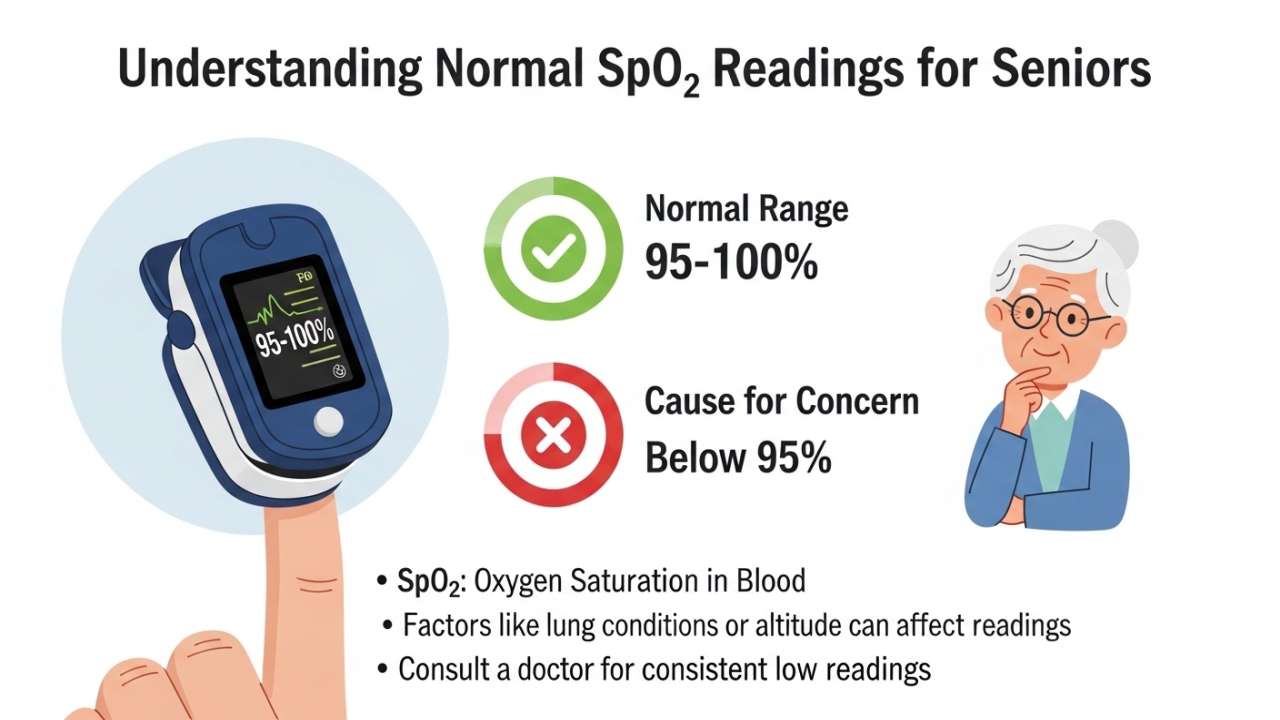
This is where many seniors get confused. Your doctor says “keep your oxygen above 90%,” but what’s truly normal? Is 94% good? Is 88% a crisis?
Normal range: For healthy adults, SpO2 typically runs 95–100%. That’s the gold standard.
Acceptable range for seniors with chronic conditions: If you have COPD, your baseline might be 88–92%, and your doctor considers that stable for you. The key is knowing what’s normal for you, not comparing yourself to a healthy 30-year-old.
Red flags:
- SpO2 below 88% without a known reason—call your doctor.
- SpO2 dropping 5% or more from your usual baseline—investigate why (activity, cold, poor positioning).
- SpO2 below 85% + shortness of breath + dizziness → call 911.
The trick is building a personal baseline. Take readings when you feel good, at rest, same time of day. After a week, you’ll know your normal. Then, changes stand out.
Key Features That Make a Pulse Oximeter Senior-Friendly
When I analyzed the top pulse oximeters selling to seniors right now, I found that the best ones share five critical traits. Here’s what separates a device that gathers dust from one you’ll actually use:
1. Large, Bright Display You Can Actually Read
Seniors lose vision acuity with age. A tiny red LCD that dims in daylight is useless. Look for:
- OLED or bright LED screens with numbers at least 1 inch tall.
- High contrast: White or bright green numbers on black background.
- Auto-rotation: Some devices flip the display based on how you hold them, so you never squint sideways.
- Visible in daylight: The screen should be readable even by a window. Many cheap models fail this test.
Pro tip: If you have to tilt the device, move to a darker corner, or put on glasses just to read “98%,” that device is poorly designed for aging eyes.
2. Simple, One-Hand Operation
Arthritis and tremors are common in seniors. A pulse oximeter shouldn’t require two hands, a manual, or hunting for the power button. Best-in-class devices:
- Large, easy-to-press power button (not a tiny recessed switch).
- Single-button operation: Turn it on, insert finger, read result. Done.
- No complex menus or settings: You shouldn’t need to navigate three screens to check your SpO2.
- Clearly labeled: Button functions should be printed on the device, not just in a booklet you’ll lose.
3. Comfortable Finger Clip for Different Hand Sizes
Not everyone has tiny fingers. Arthritis swelling, age spots, or simply natural variation means some seniors struggle with one-size-fits-all clips. Features that matter:
- Adjustable or flexible clip that doesn’t pinch.
- Soft silicone or rubber padding on the sensor area (not hard plastic that feels cold).
- Support for multiple finger sizes: The device should work on index, middle, and ring fingers without jamming or falling off.
4. Accuracy You Can Trust
A pulse oximeter that reads 87% when you’re actually at 94% is dangerous. Look for:
- FDA-cleared devices (prescription or over-the-counter). This means testing and validation.
- ±2% accuracy rating (the device may be off by 2% above or below your true value).
- Proven performance in real users: AARP and other senior organizations test these; check their recommendations.
- Reliability across skin tones: Historically, pulse oximeters read poorly on darker skin. Modern devices are improving, but it’s worth asking the manufacturer.
5. Memory and Data Tracking
If you’re monitoring regularly, you need to track trends. Options include:
- Built-in memory: Device stores the last 100+ readings with date/time. You can review trends without writing everything down.
- App connectivity: Some devices sync to your phone via Bluetooth, auto-logging readings and sending alerts if you go out of range.
- Manual log: At minimum, an easy way to write down readings (a small notepad, even).
Without tracking, a single odd reading means nothing. Patterns tell the real story.
Also Read:- Best Heart Rate Monitor for Elderly — Easy, Accurate & Doctor-Trusted Picks (2026)
Top Senior-Friendly Pulse Oximeters (2026)
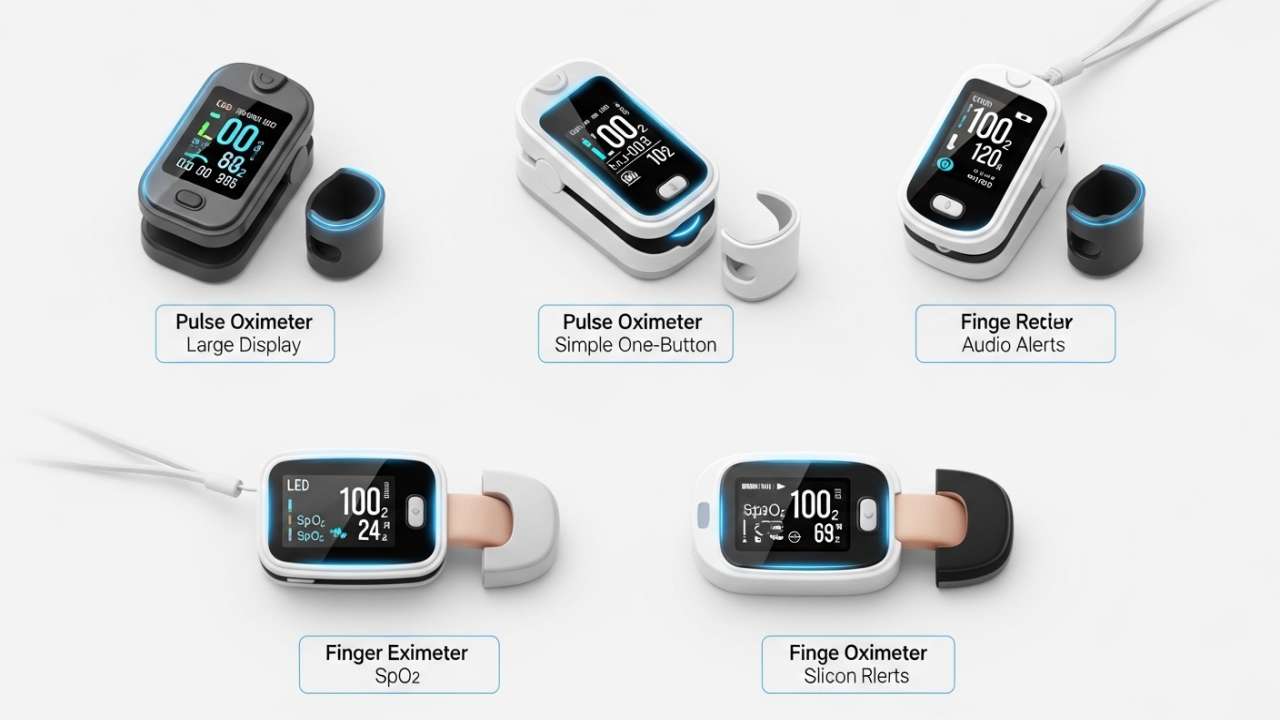
Pulse Oximeter Models and Price
| Model | Price | Display |
|---|---|---|
| Innovo Deluxe iP900AP | $60–$80 | Large LED, bright |
| Zacurate DL500 | $25–$35 | Small LED, clear |
| Masimo MightySat Rx | $200–$250 | OLED, excellent visibility |
| Oxiline Pulse XS Pro | $50–$70 | OLED, rotatable |
| Manhero Pulse Oximeter | $40–$60 | 4-way OLED, very bright |
Features, Best For, and Downsides
| Model | Key Feature | Best For | Downside |
|---|---|---|---|
| Innovo Deluxe iP900AP | Perfect accuracy + simple design | General home monitoring, arthritis hands | No app connectivity |
| Zacurate DL500 | Exceptional budget value + reliable | Budget-conscious, basic monitoring | Dimmer display, no memory |
| Masimo MightySat Rx | Clinical-grade accuracy, portable | Frequent travelers, COPD management | Expensive; requires data plan |
| Oxiline Pulse XS Pro | App included, modern design | Tech-comfortable seniors, app users | Smaller clip (not ideal for larger fingers) |
| Manhero Pulse Oximeter | Alarm for low SpO2 | Safety-focused monitoring | More complex interface |
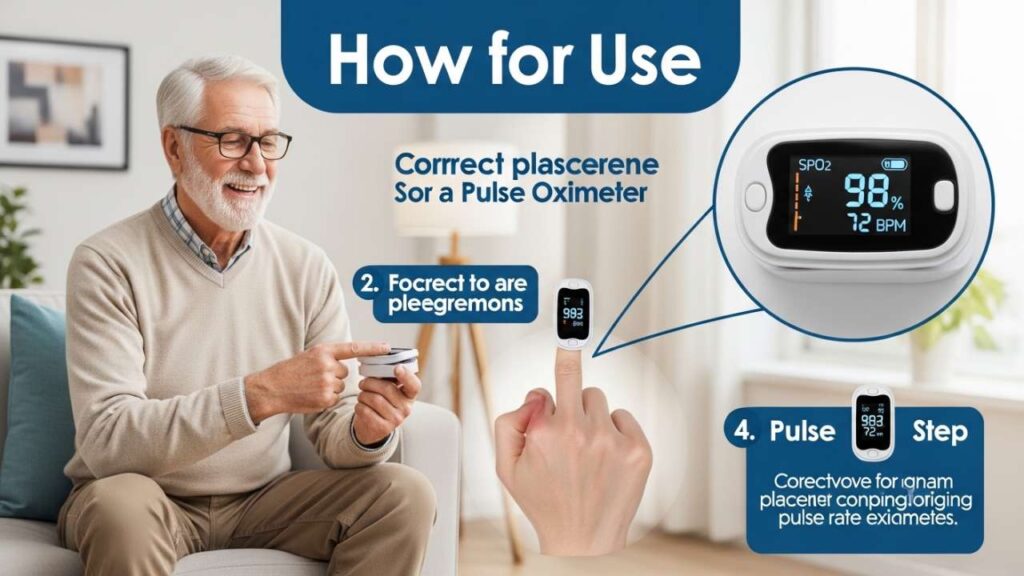
Step-by-Step: How to Use a Pulse Oximeter Correctly
Even the best device fails if you use it wrong. Here’s the exact process:
Setup (30 seconds)
- Warm your hands if they’re cold. Rub them together or run under warm water for 10 seconds. Cold hands = poor blood flow = inaccurate readings.
- Clean your fingertip: Wipe away dirt, lotion, or hand sanitizer with a tissue. These interfere with the light sensor.
- Remove nail polish if you’re wearing it. Yes, really. Thick or dark polish blocks the light and skews the reading.
Measurement (10-20 seconds)
- Power on the device.
- Insert your index or middle finger into the clip. Don’t force it—the fit should be snug but not painful.
- Keep your hand still and at heart level. This is important: hand position affects blood flow. Dangling your arm down changes the reading.
- Stay relaxed and breathe normally. Holding your breath or tensing up doesn’t help.
- Wait for the reading to stabilize. Most devices beep or blink when they’re done (usually 10-20 seconds). Don’t pull your finger out early.
Read the Result (10 seconds)
- Write down the SpO2, pulse, and time in a log or app. This builds your baseline and lets you spot trends.
- Compare to your baseline: Is this normal for you? Higher? Lower? If it’s unexpectedly low and you feel fine, take another reading on a different finger to confirm.
Also Read:- Sleep Apnea Devices for Home Use: Treatment Options for Seniors in 2026
Common Mistakes That Ruin Accuracy
Mistake 1: Cold hands
Effect: Peripheral vasoconstriction (blood vessels tighten). The sensor can’t read blood flow properly. Reading might be artificially low.
Fix: Always warm hands first. Keep a small blanket nearby.
Mistake 2: Dark nail polish or artificial nails
Effect: The sensor uses red and infrared light. Dark polish blocks it. Some devices can’t read through acrylics at all.
Fix: Remove polish on your ring finger (or the finger you’ll use) before measuring.
Mistake 3: Poor clip fit
Effect: If the device is too loose, the sensor slides around. Too tight, and you restrict blood flow. Both cause reading errors.
Fix: The clip should be snug but not painful. Adjust the position slightly if the reading looks odd, then re-measure.
Mistake 4: Hand movement or dangling arm
Effect: Tremors, fidgeting, or a drooping arm changes pressure on the sensor. Blood flow varies. Reading bounces around.
Fix: Rest your hand on a table at heart level. Tell yourself: “Still hand, still breath.” It matters.
Mistake 5: Measuring immediately after activity
Effect: Your heart is pumping hard, your oxygen is being used fast by muscles. You’ll get a naturally lower SpO2 reading than your resting baseline.
Fix: Wait 5 minutes after exertion. Sit down, breathe normally, then measure.
Mistake 6: Comparing your readings to someone else’s
Effect: Your baseline might be 92% (normal for you with COPD), while your healthy neighbor is at 98%. You panic, thinking you’re sick. You’re not—you’re just different.
Fix: Compare only to your own baseline. Only your doctor can interpret what’s normal for your specific body and conditions.
What to Do If Your Reading Is Low
Low SpO2 is scary, but panic clouds judgment. Here’s a decision tree:
SpO2 is 90-94% + you feel fine:
- Reposition your finger. Sometimes clip pressure changes the reading.
- Take another measurement in 2 minutes.
- If it stays 90–94% and you feel fine, note it and call your doctor for advice (not ER).
SpO2 is 85-89% + mild shortness of breath:
- Sit down. Rest for 5 minutes.
- Take another reading.
- If it’s still low, call your doctor’s nurse line or urgent care. Don’t drive yourself; use an ambulance if needed.
SpO2 is below 85% OR low SpO2 + severe symptoms (confusion, severe shortness of breath, chest pain):
- Call 911 immediately.
- Sit or lie down. Don’t exert yourself.
- Let the dispatcher know your SpO2 reading—it helps paramedics prepare.
The key: low readings demand action, but not always an ER visit. Context matters. That’s why tracking trends is so valuable—your doctor can spot patterns and tell you exactly what your personal threshold is.
FAQ:
Q: Will a pulse oximeter tell me if I have COVID?
A: No. A pulse oximeter only measures oxygen and pulse. It won’t diagnose COVID, the flu, or a cold. But if you have COVID (confirmed by a test), monitoring your SpO2 helps you catch serious cases early, when oxygen drops suddenly. Many seniors with long COVID use pulse oximeters at home for this reason.
Q: Can I use a pulse oximeter on my toe instead of my finger?
A: Yes, but your finger is more reliable. The toe has thicker skin and more variable blood flow, especially in seniors with poor circulation. Use your toe only if your hands are too swollen or injured.
Q: How often should I check my oxygen levels?
A: That depends on your condition. Ask your doctor. A healthy senior without respiratory issues? Maybe never. A senior with COPD in remission? Daily readings at the same time. Someone recovering from pneumonia? Several times a day during recovery. Your doctor will give you a schedule.
Q: Can I rely on my smartwatch instead of a fingertip pulse oximeter?
A: Smartwatch SpO2 readings are rough estimates. Some are decent, many are not. For casual tracking, they’re fine (“My watch says 96%”). But if your doctor says “monitor your oxygen,” they likely mean a fingertip device (more accurate) or a prescription clinical-grade oximeter. Smartwatches aren’t FDA-cleared for medical use.
Q: Why is my reading different on different fingers?
A: Slight variation is normal (1–2%). But if one finger reads 88% and another reads 96%, something’s off—poor clip placement, cold hand, or nail polish on just one finger. Re-warm and try again.
Q: What if I get a reading that seems wrong?
A: Trust your body first. If you feel fine and the reading is slightly low, take another measurement. If you feel terrible and the reading looks normal, call your doctor anyway—the device could be wrong, or something else is happening. Devices are helpful tools, not replacements for your own sense of how you feel.
Q: Is it normal for my SpO2 to drop when I walk or climb stairs?
A: Yes, a little. Exercise demands oxygen, so your SpO2 might dip slightly. But it should bounce back within 5 minutes of rest. If your SpO2 drops sharply and doesn’t recover, or if you feel dizzy, stop and sit. Talk to your doctor about safe activity levels.
Q: How do I know if my pulse oximeter is broken?
A: Test it on a healthy family member first. If it reads 96-98% on them (normal), it’s probably fine. If it reads 85% on a healthy person, it’s broken. Devices can also fail if batteries are dying (display gets dimmer) or the clip gets cracked. Clean it gently with a dry cloth; if that doesn’t help, it’s time to replace.
Q: Do I need a prescription pulse oximeter or an over-the-counter one?
A: Over-the-counter (OTC) devices are fine for home monitoring. Prescription devices are more expensive and often unnecessary. If your doctor recommends prescription-grade, they’ll tell you why (usually very tight accuracy requirements for specific conditions). OTC devices like the Innovo or Zacurate work for most seniors.