2025 Comprehensive Guide
Elderly Care Technology in Florida: Transforming Senior Lives in the Sunshine State
Updated February 2025 · ·
Florida is synonymous with retirement. White sand beaches, year-round sunshine, and a culture built around leisure have made it the destination of choice for millions of older Americans. Yet beneath this familiar image, a quiet revolution is happening — one driven not by lifestyle choices, but by urgent necessity. As the state’s senior population soars past 4.9 million and is projected to represent more than 30% of all residents by 2045, the demand for quality elderly care has never been more acute or more complex.
The traditional care model — relying almost entirely on human caregivers, family support, and nursing homes — is under mounting strain. Florida ranked dead last in a 2025 national report on aging-in-place readiness, with only one home health aide available for every 56 seniors, the worst ratio in the entire country. At the same time, more than 580,000 Floridians currently live with Alzheimer’s disease, a number expected to climb toward 720,000 by the end of 2025.
This is exactly where technology steps in — not as a cold substitute for human compassion, but as a powerful amplifier of care. From AI-powered wearable devices that monitor heart rhythm around the clock, to robotic companions that hold conversations and combat loneliness, to telehealth platforms that put a specialist on a screen in seconds — elderly care technology in Florida is evolving at a pace that would have seemed like science fiction just a decade ago.
This guide explores every dimension of that transformation: what the technology is, how it works, which Florida programs are deploying it, and what families, seniors, and caregivers need to know to make the most of it in 2025 and beyond.

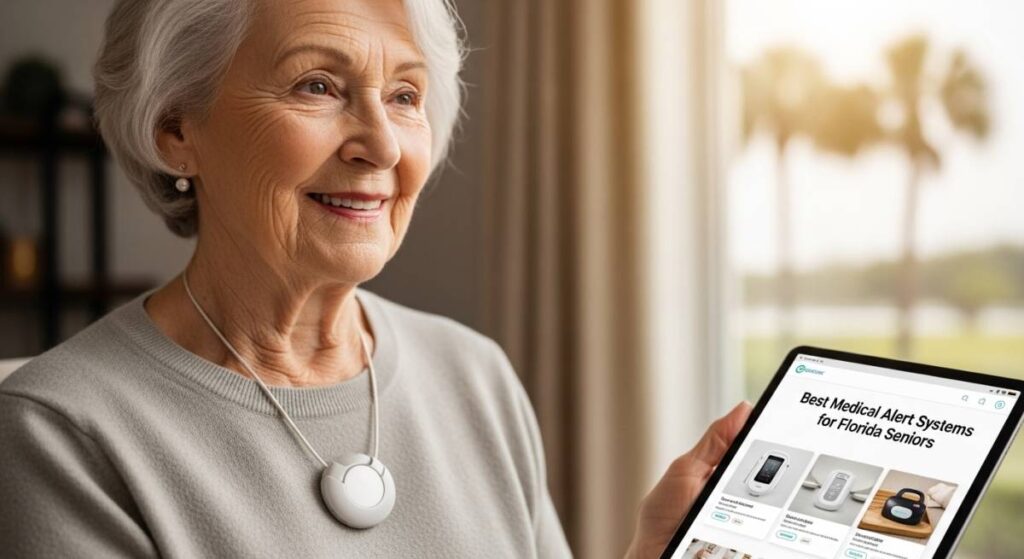
Florida seniors are embracing digital tools to stay connected, healthy, and independent.
1. Florida’s Aging Crisis: Why Technology Is No Longer Optional
To understand why elderly care technology in Florida has become such a critical priority, you need to look at the numbers. Florida has always had a large senior population — but the scale of growth now underway is unprecedented in American history.
4.9M+
Florida residents aged 65 and over (2023)
30%
Projected share of population aged 60+ by 2045
720K
Floridians expected to have Alzheimer’s by end of 2025
#50
Florida’s ranking for aging-in-place readiness (2025)
Florida’s Department of Elder Affairs manages 11 designated Area Agencies on Aging, known as Aging and Disability Resource Centers (ADRCs), each charged with coordinating services across their region. These agencies have increasingly turned to technology to bridge the yawning gap between senior needs and available human resources.
The urgency is compounded by demographic diversity. Florida’s senior population spans retirees in luxury Gulf Coast communities, low-income urban elders in Miami-Dade, isolated rural seniors across the Panhandle, and a large and growing Hispanic population for whom language access adds another layer of complexity. Effective technology solutions must account for all of these realities.
“Florida is home to approximately 6 million seniors aged 60 and older. Florida’s seniors are diverse in their demographics as well as diverse in their access, knowledge, and use of technology.” — Florida Association of Area Agencies on Aging
The economic stakes are just as high. Florida’s healthcare system dedicates a disproportionate share of its budget to managing chronic conditions — cardiovascular disease, diabetes, dementia, and mobility impairment — that disproportionately affect older adults. Technology that prevents even a fraction of emergency room visits or hospital readmissions relieves enormous financial pressure on the state and on families alike.
2. Wearable Health Monitoring: Vital Signs at Your Wrist
Wearable technology has emerged as perhaps the single most transformative category of elderly care innovation, and Florida seniors are increasingly at the center of its adoption. These devices — ranging from smartwatches and fitness trackers to specialized medical-grade sensors — continuously monitor a person’s physical state and transmit data to caregivers, healthcare providers, or emergency responders in real time.
For Florida’s older adults, the most immediately life-saving application is fall detection. Falls are the leading cause of injury-related death among adults aged 65 and older. Modern wearables use accelerometers, gyroscopes, and AI pattern-recognition to detect a fall within milliseconds and immediately alert designated contacts or emergency services — even if the wearer is unconscious or unable to call for help.
What Modern Wearables Monitor for Seniors
| Health Parameter | Technology Used | Why It Matters for Florida Seniors |
|---|---|---|
| Heart rate & irregular rhythm | Optical sensors, ECG | Early warning of atrial fibrillation, a major stroke risk |
| Blood oxygen (SpO2) | Pulse oximetry | Critical for seniors with COPD or sleep apnea |
| Fall detection | Accelerometer + AI | Immediate alert reduces response time dramatically |
| Sleep quality | Motion & heart rate analysis | Poor sleep accelerates cognitive decline |
| Blood pressure trends | Advanced optical sensors | Hypertension affects 62.6% of Florida seniors 65+ |
| Activity & mobility | GPS + step tracking | Detects functional decline before symptoms emerge |

Smartwatches track heart rate, SpO2 & detect falls 24/7.

Real-time monitoring keeps caregivers informed around the clock.
Beyond physical monitoring, wearables are increasingly being designed with cognitive health in mind. Devices that track behavioral patterns — subtle changes in walking gait, sleep timing, or activity levels — can flag early signs of dementia weeks or months before they become clinically obvious. The University of Florida and Florida International University have both become national leaders in research on wearable technology for aging populations.
3. Smart Home Technology for Florida Seniors
One of the most profound aspirations among Florida’s older adults — shared by 77% of Americans over 50, according to AARP — is the desire to age in place. Smart home technology exists precisely to make that wish sustainable by creating a safer, more manageable living environment without stripping away dignity or independence.
💡
Motion-Activated Lighting
Automatically illuminates hallways, bathrooms, and stairways at night — eliminating the most dangerous seconds of fumbling for a light switch.
🌡️
Smart Thermostats
Florida’s extreme heat is a genuine health risk for seniors. Smart thermostats maintain safe indoor temperatures and alert caregivers if conditions become dangerous.
🔐
Smart Locks & Door Sensors
Enable remote access for caregivers in emergencies, track when doors are opened, and alert family members if a senior with dementia exits unexpectedly.
📡
4D Radar Monitoring
Non-intrusive radar sensors monitor movement and fall events without cameras, preserving full privacy — used by Broward County’s Area Agency on Aging.
🍳
Smart Appliance Safety
Stove auto-shutoffs and appliance monitors reduce fire risk for seniors with memory issues — a leading cause of home injury among older adults.
🔔
Emergency Alert Systems
Personal response devices — including the EARS program offered by Florida ADRCs — ensure seniors can summon help at any moment by voice or button press.

Smart home systems let Florida seniors manage their environment safely with just their voice.
Florida’s Broward County Area Agency on Aging has emerged as a national model for deploying cutting-edge technology at the community level. Their Senior Technology Programs include the Claris Companion tablet, ElliQ AI companions, Ring doorbell programs, and radar-based in-home safety monitoring — all offered free or at low cost to eligible seniors.
4. Telehealth & Remote Care: Florida’s Digital Doctor
Transportation is one of the most consistently cited barriers to healthcare access among Florida’s elderly population. For a senior without a driver’s license, with limited mobility, or living far from major medical centers, getting to a specialist can require hours of effort and substantial cost. Telehealth technology has fundamentally changed that equation.
Approximately 7 million older adults across the country are considered homebound or face significant obstacles leaving their homes. For this population, telehealth isn’t a convenience — it’s the primary gateway to medical care. The COVID-19 pandemic accelerated adoption among seniors at an extraordinary rate, and what began as a necessity has now become a strong preference.
What Florida Seniors Can Access via Telehealth Today
- Primary care visits and follow-up consultations for chronic conditions like diabetes, hypertension, and heart disease
- Specialist appointments including cardiology, neurology, and geriatric psychiatry — without the burden of travel
- Mental health counseling, therapy, and medication management for depression, anxiety, and cognitive decline
- Telepsychiatry for dementia patients — particularly impactful given Florida’s 580,000+ Alzheimer’s sufferers
- Remote monitoring integration, where wearable data feeds directly into a clinician’s dashboard for proactive care
- Pharmacy consultations and prescription management via app-based platforms
- Physical and occupational therapy guidance via video, reducing costly in-person visits
Remote care doesn’t just benefit patients — it reduces pressure on Florida’s overstretched healthcare system. Each avoided emergency room visit or unnecessary hospital admission represents thousands of dollars in savings and preserves capacity for those with truly acute needs.
Florida’s Area Agencies on Aging have worked to ensure telehealth access doesn’t remain the exclusive province of the tech-savvy or affluent. Many agencies offer loaner tablets, broadband assistance, and digital literacy training for seniors who lack the devices or skills to participate online.
5. AI Companions & Robotic Care: Technology That Talks Back
Of all the innovations reshaping elderly care in Florida, none captures the imagination more than AI-powered companions and care robots. These are not science fiction. They are deployed today in Florida communities, and research from Florida’s own universities is shaping their development globally.
FIU’s College of Business published research examining how Florida seniors responded to AI-powered companions — specifically platforms like ElliQ from Intuition Robotics. The findings were striking: many seniors who initially expressed skepticism developed genuine, ongoing relationships with the devices over time. The robots respond to voice commands, answer questions, play music, provide medication reminders, suggest exercises and brain games, and maintain a direct communication link with the senior’s healthcare provider.
Key AI Companion Technologies Active in Florida
| Technology | Key Functions | Florida Deployment |
|---|---|---|
| ElliQ (ElliQ 3) | Conversation, reminders, vital monitoring, social connection | Broward County Area Agency on Aging |
| GrandPad Tablet | Simplified video calls, photos, music, health apps | Multiple Florida senior centers and ADRCs |
| Claris Companion | Family communication, engagement, safety reminders | Broward County senior technology programs |
| Alexa for Seniors | Voice control, reminders, smart home integration | Widely adopted across Florida communities |
| IN2L Engagement System | Cognitive engagement, reminiscence therapy, entertainment | Broward County senior programs |

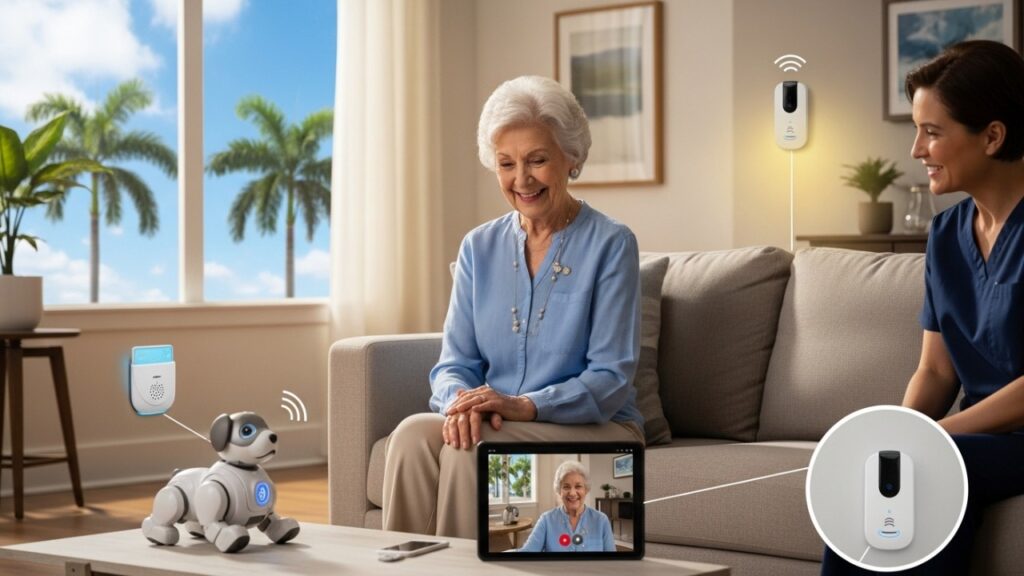
AI companions provide daily interaction and health reminders for seniors.

Telehealth connects Florida seniors to specialists without leaving home.
The loneliness epidemic among seniors — a genuine public health crisis with mortality implications comparable to smoking 15 cigarettes a day — makes AI companionship far more than a nice-to-have. For Florida seniors living alone, particularly those in rural areas, a device that engages them in daily conversation and genuinely notices when they seem low can mean the difference between depression and engagement.
Florida State University researchers have explored VR as another avenue for social connection, finding that immersive experiences — simulating a walk on a familiar beach or a family gathering — engage memory and emotion in ways that traditional activities often cannot. The ideal model treats AI companions as supplements to human care, not substitutes for it.
6. Smart Medication Management: The Right Pill at the Right Time
Medication mismanagement is one of the most pervasive and dangerous challenges in elderly care. Studies consistently show that a significant portion of hospital admissions among older adults are directly linked to medication errors: missed doses, incorrect dosages, dangerous drug interactions, or confusion over complex multi-medication regimens.
Smart medication management technology addresses this through a combination of automation, AI, and connected monitoring. Automated pill dispensers organize medications by dose and timing, provide audiovisual reminders, lock medications to prevent accidental double-dosing, and send alerts to caregivers when a dose is missed. Advanced systems integrate directly with electronic health records, allowing the entire care team to monitor adherence remotely.
How Smart Medication Systems Work
AI-powered platforms can dynamically adjust medication reminders based on a patient’s routine, detect when multiple medications should not be taken together, and send real-time notifications to both the senior and their caregiver. Voice assistants like Alexa, combined with specialized health apps, extend this capability into any room of the home — no device-checking required.
For Florida seniors managing Alzheimer’s or other forms of dementia, smart medication management isn’t just convenient — it’s essential. The combination of smart dispensers, AI reminders via companion devices, and caregiver app notifications creates a multi-layered safety net that operates around the clock. FIU researchers noted that AI platforms can be programmed to specific schedules, confirm dosages, and alert primary care providers if medications are missed — a level of personalized oversight no human caregiver could maintain continuously.
7. Florida Programs Connecting Seniors to Technology
Access to elder care technology in Florida is not limited to those who can afford premium consumer devices. A growing network of state-funded, federally supported, and nonprofit programs is working to ensure that technology reaches seniors across all income levels and geographies.
| Program / Organization | Technology Offered | Who It Serves |
|---|---|---|
| Broward County Area Agency on Aging | ElliQ companions, Claris tablets, radar monitoring, GrandPad, Ring doorbells, EARS emergency alert | Broward County seniors |
| Florida Dept. of Elder Affairs (DOEA) | Technology access, training, and digital literacy through 11 regional ADRCs | All Florida seniors aged 60+ |
| AARP Florida | Telecom device loans, digital navigation support, caregiver training | Family caregivers and seniors statewide |
| Senior Resource Alliance (Central Florida) | Wi-Fi access, tablets, digital skill-building programs | Orange, Osceola, Seminole, Brevard counties |
| UF & FIU AgeTech Research | AI, wearables, VR, and companion robotics research | Research subjects; policy and industry influence |
| PACE Programs (Florida) | Integrated medical and social services with telehealth components | Community-dwelling seniors needing nursing-level care |
The Florida Association of Area Agencies on Aging has been particularly proactive in issuing requests for innovative technology solutions — explicitly seeking platforms that reduce social isolation, enhance independence, and extend the reach of the state’s limited caregiver workforce. This creates a uniquely fertile environment for companies building elder care solutions, and means Florida seniors are among the first to access the newest tools on the market.
8. Challenges and How Florida Is Addressing Them
The Digital Divide
Many of Florida’s most vulnerable seniors — particularly those in rural communities, living in poverty, or from minority backgrounds — lack reliable internet access, do not own appropriate devices, or lack the digital literacy to use technology independently. The Senior Resource Alliance has explicitly identified this as a priority: obtaining Wi-Fi connectivity, hardware, and hands-on digital navigation support for seniors who would otherwise be left behind.
User Interface Design
Too much elder care technology is designed by and for younger people. Small text, confusing layouts, constant software updates, and interfaces that assume a baseline of app familiarity create barriers that prevent older adults from benefiting from potentially transformative tools. The University of Florida’s aging studies program emphasizes the need for interfaces that adapt to individual users — with older adults themselves involved in the design process.
Privacy and Trust
Cameras in the home, AI monitoring of behavior, and connected health data all raise legitimate privacy concerns. FIU research found that trust was the foundational prerequisite — and trust had to be earned through transparency about data use, clear control mechanisms, and consistent respect for the senior’s autonomy. Solutions that use radar or motion detection rather than cameras represent a compelling middle ground that delivers safety monitoring without visual surveillance.
Caregiver Shortage
Florida’s critical shortage of home health aides — one for every 56 seniors — means that technology must genuinely extend the capacity of available human care. The most effective programs use technology to handle routine monitoring and reminders, freeing the limited human caregiver workforce to focus on the complex, emotionally intensive aspects of care that technology cannot replicate.
9. The Future of Elder Care Technology in Florida
Looking ahead, the trajectory of elderly care technology in Florida is defined by convergence. The global AI in aging and elderly care market, valued at $47.4 billion in 2024, is projected to reach $322.4 billion by 2034 — growing at over 21% annually. Florida, as the nation’s most senior-concentrated large state, will be both a major driver of and a major beneficiary from this growth.
What to Expect in Florida by 2030
- Predictive health analytics that identify a senior’s risk of hospitalization weeks in advance, enabling proactive intervention before crises occur
- Next-generation wearables thin enough to be embedded in clothing or worn as jewelry, eliminating stigma and discomfort
- AI companions with genuine emotional intelligence — recognizing mood changes through voice tone and facial expression
- Fully integrated smart home platforms combining wearable data, environmental sensors, and AI analysis for seniors, families, and care teams
- VR therapy programs widely available in Florida senior facilities for Alzheimer’s treatment, pain management, and social engagement
- Telehealth platforms with AI diagnostic capabilities allowing at-home testing to reduce laboratory visits among seniors with mobility challenges
Technology in elder care should always serve a single ultimate purpose: allowing older Floridians to live more fully, more safely, and more independently — on their own terms, in the places they call home.

Technology empowers Florida seniors to age in place with dignity, independence, and peace of mind.
The University of Florida’s College of Medicine trains the next generation of practitioners who will combine clinical expertise with technological fluency. This investment in human capital, alongside investment in the technology itself, represents Florida’s most important long-term asset in the effort to serve its aging population with dignity, safety, and quality of life.
10. Frequently Asked Questions
What is the most important elderly care technology for Florida seniors right now? ▾
In 2025, the most impactful technologies for Florida seniors are wearable fall detection devices, smart medication management systems, and telehealth platforms. These three directly address the most common causes of preventable hospitalizations and loss of independence. Smart home monitoring and AI companions follow closely for seniors living alone.
How can low-income Florida seniors access elder care technology? ▾
Florida’s 11 Area Agencies on Aging (ADRCs) offer free or subsidized technology programs for eligible seniors, including loaner tablets, digital literacy training, and AI companion programs. Contact your regional ADRC or visit elderaffairs.org. AARP Florida and Senior Resource Alliance also provide devices and support at no cost to qualifying seniors.
Are AI companions safe and trustworthy for elderly parents? ▾
Reputable AI companion platforms like ElliQ (deployed by Broward County’s Area Agency on Aging) are built with privacy and user safety as core priorities. They do not require cameras for basic functions, data is stored securely, and most offer clear controls over what is shared and with whom. FIU research found that most seniors who used these companions over a sustained period reported positive experiences and reduced loneliness.
Does Medicare cover telehealth services for Florida seniors? ▾
Yes. Medicare expanded its telehealth coverage significantly, and many video visit services remain covered under both original Medicare and Medicare Advantage plans. Coverage specifics vary — seniors should confirm details with their plan or contact Florida’s SHINE program (Serving Health Insurance Needs of Elders) at 800-963-5337 for free, personalized guidance.
What is Florida doing to address its elder care technology gaps? ▾
The Florida Department of Elder Affairs and the Florida Association of Area Agencies on Aging are actively soliciting technology solutions through formal request-for-information processes. The state has focused on increasing broadband access for rural seniors, funding digital literacy programs, and supporting university research at UF and FIU to develop elder-centric technology.
Conclusion: Technology as a Bridge, Not a Replacement
Florida stands at a defining crossroads in how it cares for its oldest and most vulnerable residents. The challenges are enormous — a caregiving workforce stretched to its limit, a rapidly expanding senior population with complex needs, and deep inequalities in access to resources across geography and income. But the opportunities opened by technology are equally enormous.
Wearable devices that alert families to a fall in the middle of the night. AI companions that ensure a homebound senior isn’t entirely isolated. Telehealth platforms that put a cardiologist on a screen in seconds. Smart medication systems that prevent dangerous errors. Together, these technologies extend the ability of seniors to live where they choose, how they choose, with greater safety and dignity than was possible at any prior point in history.
What Florida’s best programs understand — and what its leading universities are working hard to ensure — is that technology works best when it augments rather than replaces human connection. The goal is never a world in which a robot takes care of your grandmother. The goal is a world in which technology handles enough of the routine, the monitoring, and the logistics that the human beings in her life can be fully present for the moments that actually matter.
For Florida’s millions of seniors, their families, and the caregivers who serve them, that is a future worth building toward — and in 2025, it has already begun.
Also Read: – Best Medical Alert Systems for Florida Seniors: Complete 2026 Guide